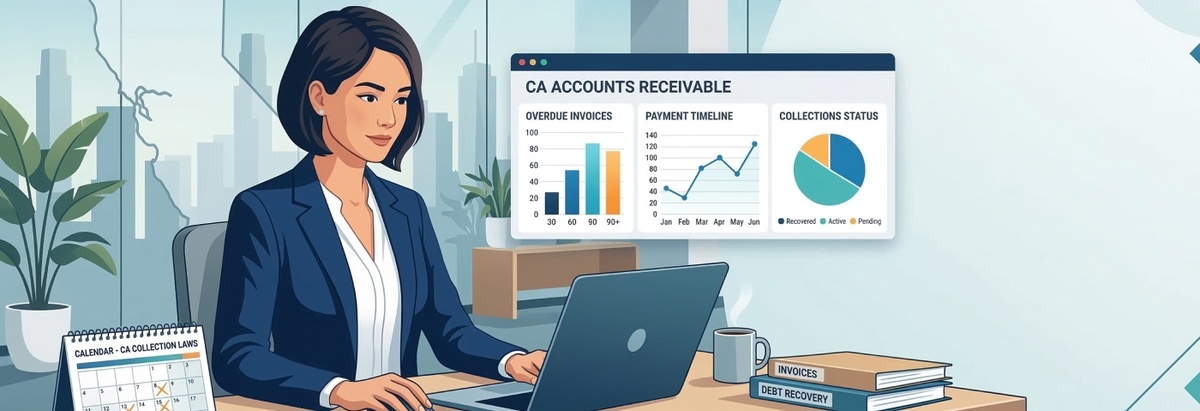
Late payments are one of the most persistent challenges in business finance. Even well-run companies with strong customer relationships eventually face overdue invoices or unpaid contracts. When that happens, business owners and financial managers often ask an important question: how long can debt collectors try to collect in California?
Understanding the legal timeline for debt recovery is essential for companies that want to protect their revenue and maintain healthy cash flow. California law places limits on how long creditors can pursue legal action to enforce payment. These deadlines are known as statutes of limitations, and they determine whether a creditor can still file a lawsuit to collect a debt.
For entrepreneurs, CFOs, and accounts receivable teams, knowing these time limits can help guide collection strategies and avoid losing valuable recovery opportunities. This article explains how California’s collection timelines work, why they matter for commercial debts, and how platforms like Retrievables help businesses pursue outstanding receivables more effectively.
Why Debt Collection Timelines Matter for Businesses
Most companies rely on predictable cash flow to sustain operations. When clients fail to pay on time, that predictable revenue becomes uncertain.
Unpaid invoices can create ripple effects across an organization. Finance teams may need to delay investments, operations departments may struggle with supplier payments, and leadership may face unexpected financial pressure.
Beyond operational concerns, businesses also face legal deadlines when collecting debts. If a creditor waits too long before pursuing formal recovery actions, they may lose the ability to enforce the debt through the court system.
For organizations that regularly extend payment terms to customers, understanding these legal timelines is an important part of financial risk management.
Understanding the Statute of Limitations in California
The statute of limitations establishes the period during which a creditor can file a lawsuit to recover unpaid money.
Once this period expires, the debt does not necessarily disappear. However, the creditor typically loses the ability to obtain a court judgment forcing the debtor to pay.
California applies different limitation periods depending on the type of agreement that created the debt.
For businesses, these timeframes often revolve around whether the agreement was documented in writing.
The Four-Year Rule for Written Agreements
Most business transactions are based on written contracts. These may include service agreements, purchase orders, vendor contracts, or credit arrangements between companies.
In California, debts arising from written contracts generally carry a four-year statute of limitations.
This means a creditor normally has four years from the date of default to file a lawsuit seeking repayment.
Because commercial transactions are typically documented, the four-year rule applies to a large percentage of business debts.
Examples of written obligations include:
- Signed consulting agreements
- Vendor supply contracts
- Equipment purchase agreements
- Commercial credit arrangements
- Written loan agreements between companies
For businesses managing large volumes of invoices, tracking this four-year timeline is essential.
Two-Year Limit for Verbal Agreements
Not every business deal is documented formally. In some cases, companies enter into verbal agreements regarding services or payment terms.
When a debt arises from an oral agreement, California law generally allows two years to file a lawsuit.
Although oral contracts are legally recognized, they are more difficult to prove. Without written documentation, the creditor may need additional evidence such as communications, invoices, or witness testimony.
For this reason, most companies prefer to formalize agreements in writing whenever possible.
When the Legal Clock Starts
A key detail that often surprises business owners is that the statute of limitations does not begin when a contract is signed.
Instead, the timeline usually begins when the debtor fails to meet their payment obligation.
In practical terms, this means the clock typically starts when a payment becomes overdue.
For example, imagine a consulting firm issues an invoice with payment terms of 30 days. If the client fails to pay by the due date, that missed payment marks the beginning of the legal timeline for pursuing collection through the courts.
From that point forward, the creditor must act within the applicable statute of limitations if they want the option of legal enforcement.
What Happens When the Statute Expires
When the statute of limitations passes, the debt becomes legally time-barred.
This does not automatically eliminate the debt. Instead, it means the creditor typically cannot rely on the court system to enforce payment.
Collection attempts may still occur through voluntary methods such as negotiation or settlement discussions. However, without the possibility of litigation, creditors may have less leverage in recovering the balance.
For businesses, this highlights the importance of monitoring overdue accounts carefully and acting before legal deadlines expire.
Events That May Restart the Timeline
In some situations, the statute of limitations may reset if the debtor takes actions that acknowledge the debt.
These actions might include:
- Making a partial payment
- Signing a written acknowledgment of the debt
- Agreeing to a revised repayment schedule
When this happens, the legal timeline may begin again from the date of the new activity.
Because these situations depend on specific circumstances, companies often consult collection professionals or attorneys to determine how the timeline applies to their case.
Why Commercial Debt Collection Is Different
Debt collection between businesses differs significantly from consumer debt recovery.
Commercial debts often involve more complex relationships, larger amounts of money, and detailed contractual terms.
Higher Financial Stakes
Business debts can be substantial. A single unpaid invoice may represent a large portion of expected monthly revenue.
Contractual Complexity
B2B agreements frequently include clauses addressing:
- Late payment interest
- Responsibility for legal fees
- Collection costs
- Jurisdiction for disputes
These provisions can influence how collection efforts proceed.
Ongoing Business Relationships
Unlike consumer collections, companies sometimes prefer to maintain relationships with clients even while pursuing payment.
Navigating these dynamics requires careful communication and expertise.
Why Early Collection Efforts Improve Outcomes
Time is one of the most important factors in successful debt recovery.
As debts age, the likelihood of recovery often decreases.
Several challenges can arise as time passes:
- Financial instability of the debtor
- Loss of documentation
- Reduced leverage
A company struggling to pay invoices may eventually close or declare bankruptcy.
Older records can become harder to locate, particularly in organizations with high employee turnover.
The longer a debt remains unpaid, the less urgency the debtor may feel to resolve it.
For these reasons, many finance teams escalate accounts that remain unpaid after 60 to 90 days.
Practical Strategies for Managing Business Receivables
Companies can significantly reduce bad debt risk by adopting structured receivables management practices.
Establish Clear Payment Terms
Every contract should clearly define payment expectations, including due dates and consequences for late payment.
Monitor Accounts Receivable Aging
Regular review of aging reports allows businesses to identify potential problems early.
A typical aging structure might include:
| Aging Period |
Typical Response |
| 0–30 days |
Routine follow-up |
| 31–60 days |
Reminder notices |
| 61–90 days |
Escalated communication |
| 90+ days |
External collection |
Escalate Strategically
If internal collection efforts fail, involving external professionals can significantly increase recovery chances.
How Retrievables Helps Businesses Recover Commercial Debts
Recovering overdue payments can require expertise that many organizations do not have internally. This is where Retrievables provides a valuable solution.
Retrievables focuses on commercial debt collection and helps businesses identify the most appropriate recovery professionals for their situation.
Rather than acting as a traditional collection agency, Retrievables connects companies with experienced collection attorneys and agencies that specialize in business-to-business debt recovery.
Matching Businesses With the Right Recovery Partner
Not all debts require the same approach. Some cases can be resolved through negotiation, while others may require litigation.
Retrievables helps businesses evaluate their options and connect with professionals who have experience handling similar claims.
Simplifying the Collection Process
For finance teams, finding reliable collection partners can be time-consuming. Retrievables streamlines this process by providing access to a network of vetted professionals.
This allows businesses to focus on operations while experienced specialists handle the recovery process.
Built for Commercial Claims
Unlike many platforms that focus on consumer debt, Retrievables is designed specifically for B2B debt recovery.
Industries that frequently benefit from these services include:
- Technology and SaaS companies
- Manufacturing and distribution businesses
- Logistics providers
- Professional services firms
- Large enterprises managing extensive receivables
By connecting businesses with experienced professionals, Retrievables helps companies pursue unpaid invoices efficiently and professionally.
Frequently Asked Questions
How long do debt collectors have to sue for a debt in California?
For most written agreements, creditors typically have four years from the date of default to file a lawsuit.
Does the statute of limitations apply to commercial debts?
Yes. Business debts are subject to the same legal deadlines, although the timeframe depends on the type of contract.
Can a debt still be collected after the statute of limitations expires?
Collectors may still request voluntary payment, but they generally cannot enforce the debt through litigation once the deadline passes.
What actions may restart the statute of limitations?
Partial payments, written acknowledgment of the debt, or a new payment agreement may restart the legal timeline.
When should businesses consider using a collection service?
Many organizations involve professional collectors when invoices remain unpaid for 90 days or more.
How does Retrievables help businesses recover debt?
Retrievables connects companies with experienced commercial collection attorneys or agencies best suited to handle their specific claim.
Conclusion
For businesses managing accounts receivable, understanding how long debt collectors can try to collect in California is essential. In many commercial cases, creditors have four years to pursue legal enforcement for debts tied to written contracts. Waiting too long to act can significantly reduce recovery options.
Entrepreneurs and financial leaders should treat overdue invoices as a strategic priority. Monitoring receivables closely, escalating collection efforts at the right time, and working with experienced professionals can improve recovery outcomes.
Platforms like Retrievables make this process easier by helping businesses find the most suitable commercial collection attorney or agency for their case. By connecting companies with the right expertise, Retrievables helps organizations recover outstanding debts while maintaining professional and efficient financial operations.